The Story So Far
Before I understood organizations, I understood stories.
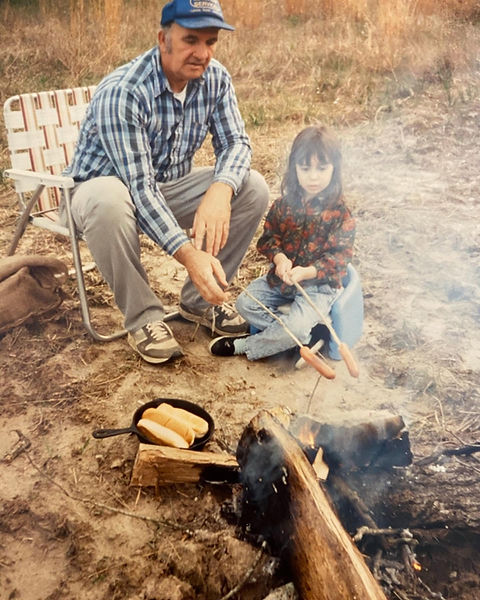
The earliest I can recall begin with heat—heavy, shimmering sheets of it, sticky-thick with humidity and the swelling buzz of cicadas. In the East Texas summers of my childhood, the best way to coax a breeze was from the swing of my grandaddy's hammock. My siblings and I would clamber onto its sun-warmed weave like little spiders, the cotton ropes leaving damp diamond patterns on our backs and legs as we settled. He would anchor the middle, spinning strands of fact and fiction into stories somehow both wildly impossible and absolutely true.
Some were about Mishna, my fearless alter ego—a young Native American girl who, alongside her pony Wildfire, protected her people from mountain lions, bandits, and whatever other trouble Grandaddy decided needed defeating that afternoon. Others were his "real" stories: outsmarting alligators on the Trinity River, battling water moccasins, or keeping watch for the bobcat who routinely stole his bacon rinds. Every retelling grew a little larger, and my mind lingered over every word.
When he wasn't spinning stories, we were making them. We pulled bait traps from the pond to see whether we'd caught perch, hunted for arrowheads in dry riverbeds, climbed trees for huckleberries, and slipped through a gap in the neighbor's barbed wire fence to pick the biggest blackberries (well known to be in their cow pasture). At night we shelled cream peas from his garden, played checkers by the fire, and listened to the frogs trill their twilight chorus as dusk darkened the surrounding pines.
Looking back, I realize he wasn’t just teaching me to tell stories. He was instructing me in how to see—to notice the details other people hurry past, to find wonder in ordinary places, and to believe that every experience holds something of value. He taught me to approach the world with equal parts imagination and observation, to follow my curiosity, and to trust that the next good question is usually worth more than the last good answer.
My mother carried that tradition forward in her own way. As a journalist, she transformed our family's everyday scrapes, misadventures, and small-town life into weekly newspaper columns that somehow made the mundane feel magical. Stories were how we attached meaning to life, and I think that's why I've spent my life chasing them. At their heart, every story is an adventure and every adventure begins with curiosity. Where does this road lead? What happens if I say yes? What might I discover if I keep going?
The older I became, the curiosity remained but the questions changed. I became fascinated not only by where people lived, but by how they lived. Why cultures differ. Why ideas spread. Why some communities thrive while others fragment, and why certain leaders inspire trust while others only command authority. That train of thought may seem far removed from the hammock, but to me, it's always been the same story—the questions have simply grown larger. It's not been a conventional career, and I'm grateful for that. Every chapter has taught me something unique.
After studying rhetoric and writing at The University of Texas at Austin, I moved to Los Angeles where I spent most of my twenties.The earliest years of my career were spent learning how experiences affect people. Through event production, marketing, communications, and experience design, I became interested in the play between logistics and emotion—how countless invisible details come together to make someone feel welcomed, inspired, connected, or transformed. It was my first lesson that thoughtful systems, much like thoughtful stories, can profoundly shape the human experience.
At twenty-five, I bootstrapped my first business, adding entrepreneurship to my love of creating experiences. Then for nearly a decade, the world was my classroom. Working in travel gave me the extraordinary advantage of experiencing dozens of countries and cultures. I advised some of the world's most discerning travelers, spoke throughout the industry, and was honored to receive recognition I never imagined when I first entered the field. At thirty, I decided to spend half a year abroad traveling through 23 countries. This remains one of the most formative seasons of my life.
Travel's greatest gift has never been access— it is perspective. Standing in places I had once dreamed about, I realized that what captivated me wasn't the destination alone; it was the people who called it home. Every culture offered another answer to the enduring questions about belonging, purpose, and what it means to live well. Travel also taught me humility. The world is infinitely larger, stranger, and more beautiful than any one perspective can hold. Curiosity, I've found, is less about collecting answers than continually expanding the questions we're willing to ask.
Returning to the states, I opened Protravel’s flagship office in Texas; my second business, a boutique consultancy; and continued building experiences centered on connection, hospitality, and community. Then, like so many stories, mine took an unexpected turn and the pandemic carried me into the entirely alien world of corporate culture.
For the last five years, I've helped expand Culturati, an organization dedicated to advancing conversations around culture, leadership, organizational health, AI, and the future of work. As COO of a lean 501(c)(3), I've worn many hats—building systems, designing experiences, leading operations, shaping strategy, writing thought leadership, cultivating partnerships, and helping a small team create an outsized impact.
I've found myself behind the scenes with CEOs, founders, military leaders, bestselling authors, researchers, entrepreneurs, and executives from organizations of every shape and size. Curiosity led me into conversations with hundreds of leaders wrestling with the same questions: How do we build better companies? How do we earn trust? How do we navigate uncertainty? How do we create cultures where people don't simply succeed, but flourish?
And I realized something unexpected. Despite their different industries, backgrounds, politics, and personalities, the most thoughtful leaders weren't defined by certainty. They were defined by humility. They asked better questions. They listened carefully. They changed their minds when presented with better evidence. They cared as much about character as competence. They understood that every strategy eventually becomes culture, and every culture eventually shapes the lives of real human beings. That lesson has deeply impacted me.
The longer I work, the less interested I am in titles, trends, or management fads. I'm interested in the conditions under which people flourish. I'm interested in how trust is built, how wisdom is cultivated, how communities strengthen one another, and how organizations become places where people leave better than they arrived. Artificial intelligence has only sharpened those questions. I'm fascinated by AI—not because I believe technology is the only defining story of our era, but because it reminds us that humanity is. Every generation inherits more powerful tools than the one before it. What determines whether those tools elevate civilization or diminish it has never been the technology itself. It has always been the judgment, ethics, imagination, curiosity, and character of the people using it.
Professionally, I still love exploring, creating, and building. I enjoy bringing clarity to complexity, translating ideas into action, convening remarkable minds around meaningful questions, and creating experiences that continue to transform people.
Personally, I'm still chasing horizons. These days, home has four wheels and a ball-obsessed Rottweiler named Raya. I recently bought a travel trailer with the plan of leaning into our remote-first policy and spending the next couple of years working while exploring North America. I find I'm happiest when hiking a new trail, kayaking with Raya, lingering over great food and wine, or getting lost in a bookstore.
As it turns out, the next chapter may be asking to be written a little differently. I'm not sure yet what it will look like, but if I've learned anything, it's that the greatest journeys rarely unfold as planned. I am fortunate to have an incredible circle of friends scattered across the country—people with wildly different backgrounds, professions, beliefs, and life experiences who continually challenge, encourage, and expand my thinking. They remind me that some of life's greatest moments happen around a dinner table. And back home, my favorite title has nothing to do with my career. To two wonderful nieces and one rambunctious nephew, I'm their beloved "DoDo"—the quirky aunt who tells the best stories because I do all of the funny voices.
And like my grandfather did for me, what I hope they'll learn is to never outgrow their sense of wonder. I haven't. At times it may get buried, but it’s never burned out, and I've discovered that the greatest frontiers aren't hidden on old maps, but inside each of us. Helping individuals flourish, organizations become more deeply human, and contributing to a future worthy of our remarkable potential has become the adventure of my life. And somehow, I think Grandaddy would be proud of how the story is unfolding.
To the unwritten pages ahead,